Tampa properties face persistent pressure from subterranean species, particularly the aggressive Formosan subterranean termite (*Coptotermes formosanus*) and native eastern subterranean termites (*Reticulitermes…
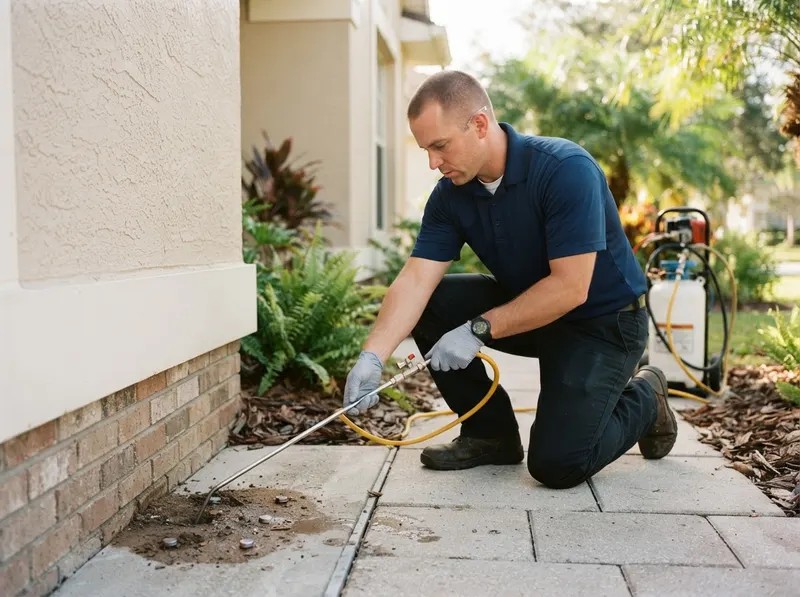
Tampa properties face persistent pressure from subterranean species, particularly the aggressive Formosan subterranean termite (*Coptotermes formosanus*) and native eastern subterranean termites (*Reticulitermes flavipes*). In older historic bungalows across Seminole Heights, Tampa Heights, and Ybor City, off-grade crawlspace foundations leave joists closer to damp soil, creating direct travel routes for workers constructing shelter mud tubes. In newer slab-on-grade builds in New Tampa and Westchase, colonies enter through bath-trap cutouts and expansion joints in the concrete slab where high ground moisture from Hillsborough County summer rains accumulates. Liquid non-repellent termiticides bind directly to the soil particles at a depth of 6 inches, allowing foraging termites to pass through the treated zone undetected, carry the active material back to the subterranean nest, and transfer it through social grooming to neutralize the reproductive queen.
Selecting the right perimeter method depends on foundation architecture, soil drainage, and proximity to open water. Liquid trench treatments suit monolithic concrete slabs typical in Palma Ceia and Ballast Point, providing continuous barrier protection for up to 5 to 10 years without requiring ongoing monthly disruption indoors. Conversely, properties near the waterline on Davis Islands, the Channel District, or alongside Bayshore Boulevard frequently encounter shallow water tables where continuous trenching requires careful containment; non-invasive exterior bait stations installed every 10 to 15 linear feet serve as the preferred defensive system to eliminate colonies without broad soil saturation. The decision hinges on immediate structural pressure versus long-term environmental sensitivity: liquid treatments halt active foundation breaches within 30 to 90 days, whereas baiting systems offer continuous exterior monitoring and structural colony collapse with zero indoor chemical exposure to children or family pets.
Effective subterranean termite defense follows a three-step protocol that eliminates guessing and avoids unnecessary multi-year service contracts. Step 1: Technicians conduct an exhaustive tactile inspection of baseboards, stem walls, and crawlspace piers to map active mud tubes and identify localized moisture leaks. Step 2: The foundation perimeter is prepared by trenching 6 inches wide by 6 inches deep or drilling exterior expansion joints where concrete abuts the home exterior. Step 3: Calibrated liquid termiticide is pumped into the root soil zone, or exterior monitoring stations are anchored flush with the turf line to create an unbroken defensive envelope. Technicians hold verified state pesticide certification under the Florida Department of Agriculture and Consumer Services (FDACS), ensuring every indoor and outdoor application adheres strictly to label specifications designed for high-humidity coastal environments.
Every job gets a firm, written price after a free on-site visit.
Tell us about your subterranean termite treatment job in Tampa and we'll send a clear, written quote, usually the same day.
 Gulf Finch Pest Control